
Batman and Joker as Doubles
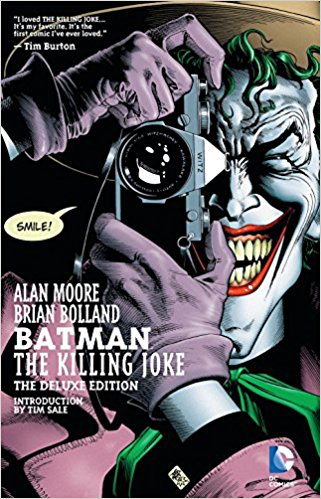
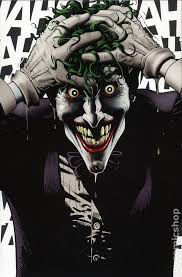
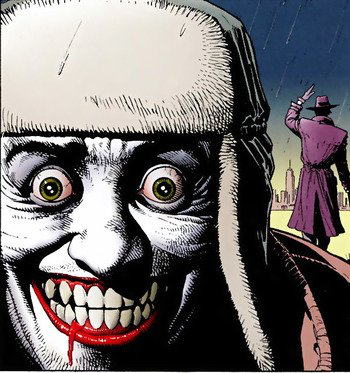
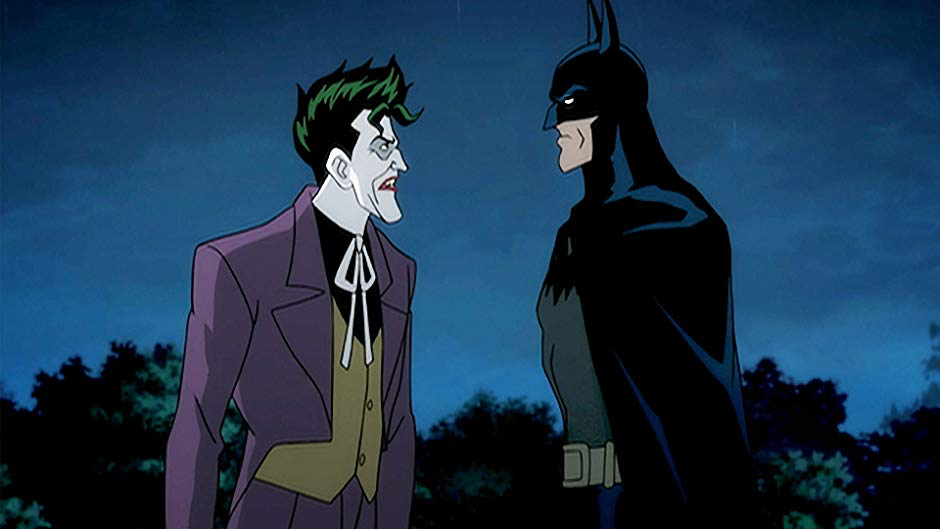
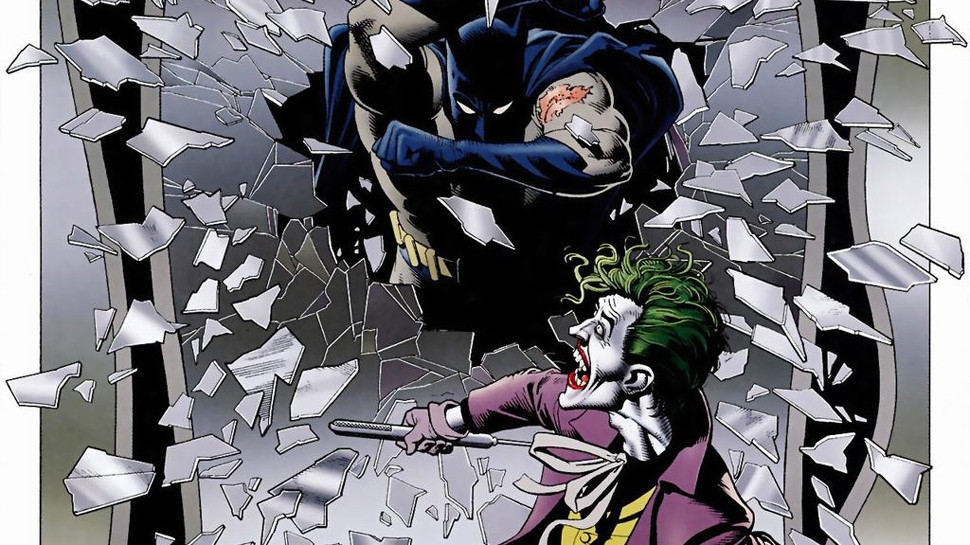
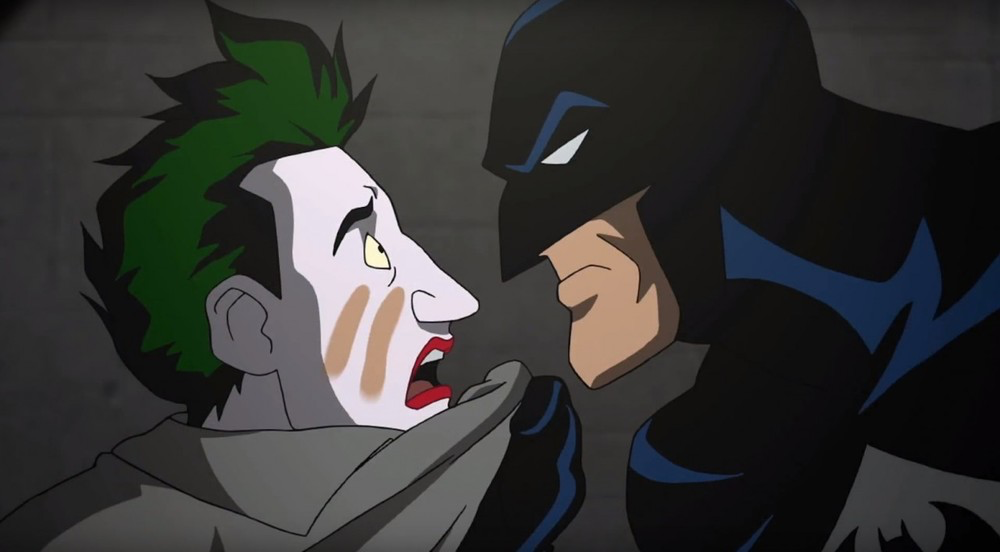
Batman and Joker are doubles for each other in the comic book, The Killing Joke. Their futures are entwined, their pasts are similar, and their present is spent more closely aligning with each other, than any average person. For example, Batman says to Joker, “I’ve been thinking lately about you and me. About what’s going to happen to us. In the end. We’re going to kill each other, aren’t we?” Therefore, Batman has been contemplating what is going to happen to both the Joker and himself, as if what happens to one informs what happens to the other. He concludes that they are going to “kill each other,” but doesn’t specify who will kill who. This sort of vague language is reminiscent of the language surrounding Laura and Lizzie’s body parts in “The Goblin Market.” It doesn’t matter who will kill who, as they are one of the same, doubles for each other. In fact, later in the comic when Batman and Joker are fighting, Batman breaks through a mirror to get Joker. This scene is in the pictures above. Batman literally bursts through Joker’s reflection, which implies that Batman is part of Joker’s reflection on the mirror, and thus, part of Joker.
A Freudian Reading of Batman and Joker as Doubles
Obviously, Joker is the id, as he does horrible acts that hurt society, such as attempting to traumatize the police commissioner. Batman is the superego. Batman being the superego isn’t as initially clear, as Batman does do violent acts that are sometimes against the law. For example, Batman is overly violent with the fake Joker in the asylum and Gordon has to rush in to stop Batman. However, going back to Freud, the superego is supposed to help society and regulate or restrain the id. Batman does do this, as he does his best to protect society from Joker, at least in this specific comic. Thinking about Batman and Joker as doubles and as the superego and id of one being, the end of the comic can be read in a different way. The laughs of Joker and Batman are separate throughout the whole comic book, as Joker laughs with ha ha’s and Batman laughs with heh heh’s. Yet, the end mixes this laughter, first in speech bubbles where both Batman and Joker are laughing with variations of he he, and the the speech bubble disappears entirely with just ha ha’s on the image. Therefore, the laughs between the two are now indistinguishable. In this way, Batman and Joker are becoming one person again, and the id and superego is merging in a normal human way, as all human psyche’s contain both the id and the superego. The end is a reconcilliation of the id and the superego, and having the merge between an id and a superego creates a fully functioning and normal person. Therefore, the image cuts away from the two characters and the lights go out as the story ends due to their reconcilliation and regulation of each other.
Implications for Gothic Literature
The Killing Joke is much more recent then Frankenstein and “Goblin Market” (as seen in the timeline). Yet, this comic still has implications for both past gothic literature and future gothic genre. As noted in the implications Frankenstein had, The Killing Joke also humanizes monstrosity in a terrifying way. Afterall, Joker says, “I’ve demonstrated there’s no difference between me and everyone else! All it takes is one bad day to reduce the sanest man alive to lunacy. That’s how far the world is from where I am. Just one bad day.” Joker’s duplicity with Batman, and thus a supervillian’s duplicity with a superhero, exposes how monsters aren’t that different from the readers. “One bad day” separates Batman from Joker, the reader from Joker, and the world from devastation. Even though Joker is fantastic, and not realistic, he has a backstory steeped in realism. This element of realism as the origin for the fantastic is how gothic literature works. The characters in gothic literature never believe beforehand in the supernatural, or the fantastic. However, through the realism, the supernatural and the fantastic are able to infiltrate in a way that makes the reader more able to apply the terror of the story to the real world.
 Doubles in Gothic Literature